 bb865a4fea
* Implement Containers (Dictionary,Set,Array) on top of MerkleTree. And restructure the code.

- Reorganize the code grouping backends, middleware, frontend, (crypto) primitives.
- Add types Dictionary,Set,Array at the middleware layer, so that
  it can be used both by the backend and frontend. The Dictionary, Set,
  Array use the merkletree differently as specified at
f2575d1524/book/src/values.md (dictionary-array-set)
	- The containers introduce the trait Container, which has the
	  method 'cm()'. At the current version this uses a merkletree
	  under the hood, and the method 'cm' returns the merkle root.
- Ideally neither frontend nor backend use the MerkleTree type, and they
  use the wrappers {Dictionary,Set,Array}. Note that the current commit
  the MerkleTree is used at the mock-backend to check internal values, but
  not at the struct types.
- updated the spec's merkletree section updating the defined interface
- add github ci to run the tests

---------

Co-authored-by: Ahmad Afuni <root@ahmadafuni.com>
Co-authored-by: Eduard S. <eduardsanou@posteo.net>
8.2 KiB
MerkleTree
In the POD2 backend, a MerkleTree is used to store an unordered set of key-value pairs. The frontend compound types Array, Set, and Dictionary are all represented as MerkleTrees on the backend.
From the high level, we can think of a MerkleTree as a 'hashmap' storage, that allows us to generate proofs of inclusion and non-inclusion of the key-values stored into it.
A MerkleTree is represented in-circuit as its Merkle root; in the Plonky2 backend, this root is a tuple of four field elements. This makes a MerkleTree the same size in-circuit as the atomic types Integer and String. (In general, regardless of the proof system used on the backend, all three types are represented in-circuit by the same number of field elements; this number is determined by the security requirement of the hash function.)
The encoding of the MerkleTree is a recursive process:
- Encode all keys and values in the
MerkleTree. - Put all keys and values into a sparse Merkle tree.
- The
MerkleTreeis encoded in-circuit as the root of this sparse Merkle tree.
This document explains the construction of the sparse Merkle tree.
The branching rule
A sparse Merkle tree is implemented as a binary tree. The insertion path of any key is given by a deterministic rule: given key and a nonnegative integer depth, the rule determines that key belongs to either the left or right branch at depth depth.
The precise rule is as follows. In-circuit, compute a Poseidon hash of key to obtain a 4-tuple of field elements
Poseidon(key) = (k_0, k_1, k_2, k_3).
Write the field elements in binary (in little-endian order):
k_0 = b_0 b_1 ... b_63
k_1 = b_64 b_65 ... b_127
....
At the root, key goes to the left subtree if b_0 = 0, otherwise the right subtree. At depth 1, key goes to the left subtree if b_1 = 0, otherwise the right subtree, and similarly for higher depth.
The tree structure
A Merkle tree with no entry at all is represented by the hash value
root = hash(0).
(With the Plonky2 backend, the hash function hash will output a 4-tuple of field elements.)
A Merkle tree with a single entry (key, value) is called a "leaf". It is represented by the hash value
root = hash((key, value, 1)).
A Merkle tree tree with more than one entry is required to have two subtrees, left and right. It is then represented by the hash value
root = hash((left_root, right_root, 2)).
(The role of the constants 1 and 2 is to prevent collisions between leaves and non-leaf Merkle roots. If the constants were omitted, a large Merkle tree could be dishonestly interpreted as a leaf, leading to security vulnerabilities.)
Example 1
Suppose we want to build a Merkle tree from the following Dictionary with three key-value pairs:
{
    4: "even",
    5: "odd",
    6: "even"
}
The keys are integers, so the are represented in-circuit by themselves. Let's suppose that in little-endian order, the first three bits of the hashes of the keys are:
hash(4) = 000...
hash(5) = 010...
hash(6) = 001...
The resulting tree looks like:
                        root
                         /\
                        /  \
                       /    \
                      /      \
                   L_root   R_root = hash(0)
                     /\
                    /  \
                   /    \
                  /      \
               LL_root  LR_root = hash((4, "even", 1))
                 /\
                /  \
               /    \
              /      \
        LLL_root   LLR_root = hash((5, "odd", 1))
          ||
  hash((6, "even", 1))
The intermediate roots are computed as hashes of their subroots:
LL_root = hash((LLL_root, LLR_root, 2))
L_root = hash((LL_root, LR_root, 2))
root = hash((L_root, R_root, 2)).
The full Dictionary is then represented in the backend as root (four field elements in the Plonky2 backend).
Example 2
So for example, imagine we have 8 key-pairs, where the keys are just an enumeration from 0 to 7, then the tree leaves positions would look like:
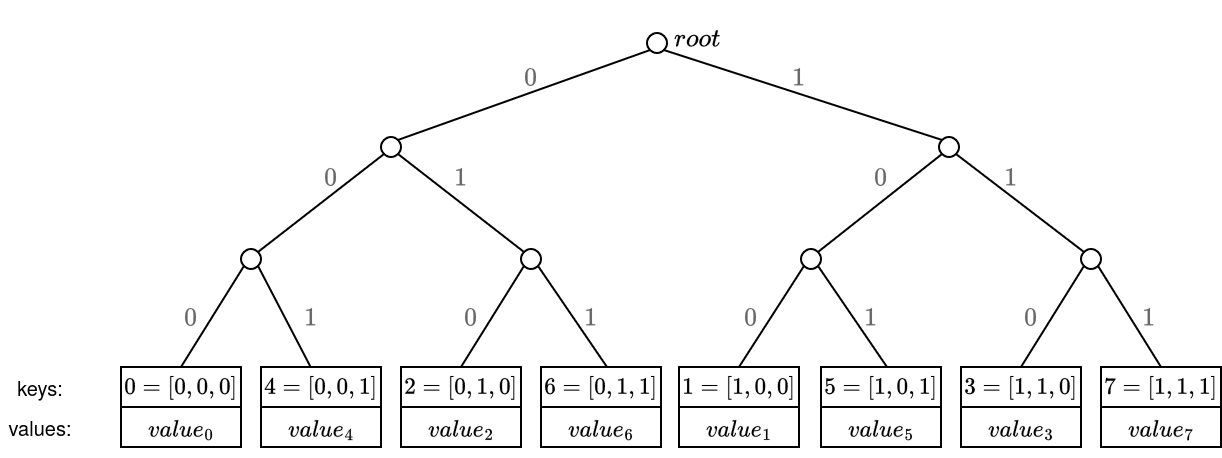
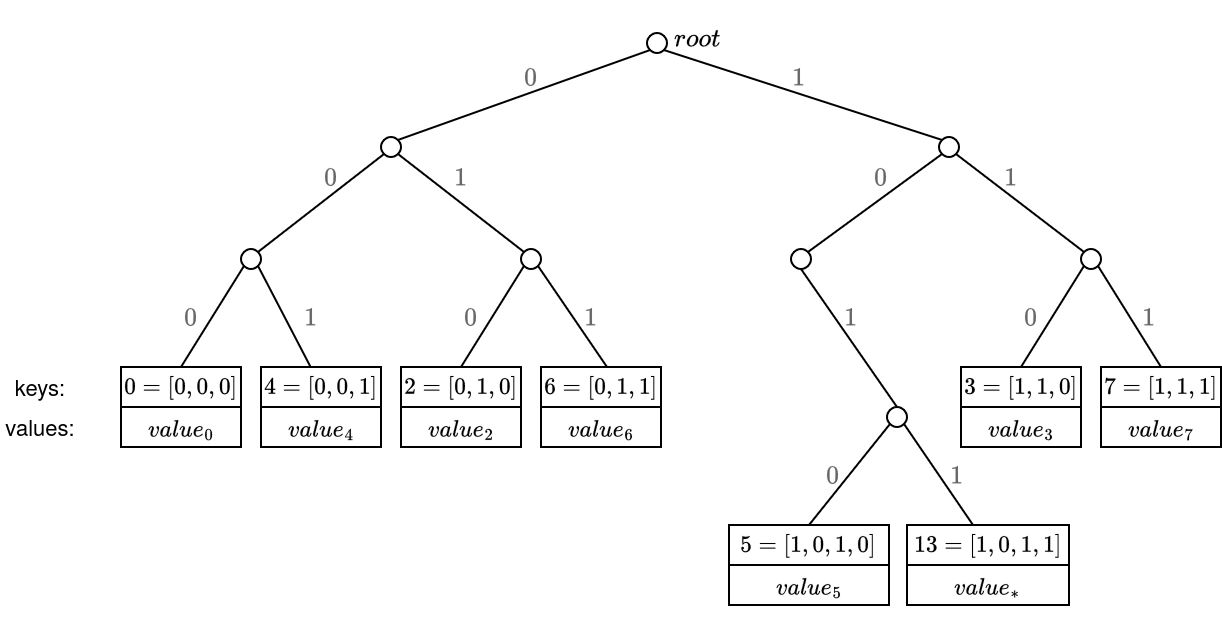
Now let's change the key of the leaf key=1, and set it as key=13. Then, their respective leaf paths will be the same until they diverge in the 4-th bit:
Example 3
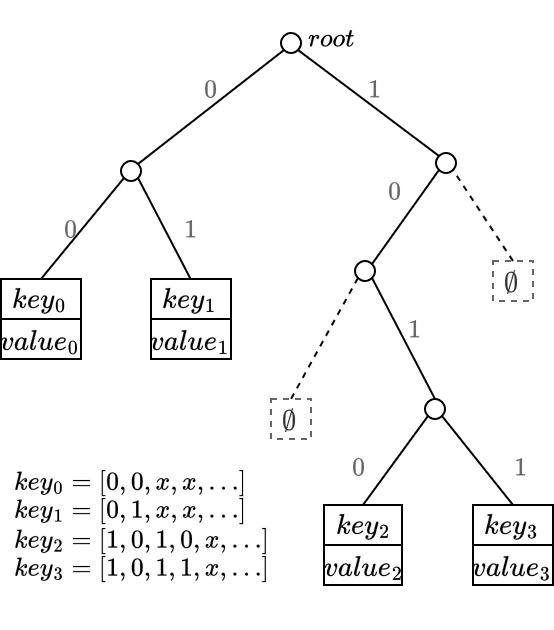
Suppose we have 4 key-values, where the first four bits of the hashes of the keys are 0000, 0100, 1010 and 1011. The tree would look like:
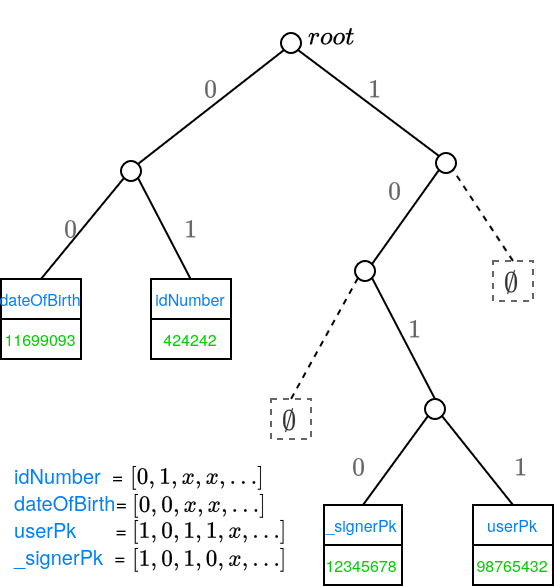
To iterate this example, suppose we have the following data in a POD:
{
	id: "11000...",
	kvs : {
		idNumber: "424242",
		dateOfBirth: 1169909384,
		userPk: 9876543210, // target user of this POD
		_signerPk: 1234567890, // signer of the POD
	},
	// ...
}
The merkletree will contain the key values from the kvs field.
Suppose that the binary representation of the hash of the key userPk is 1011.... This uniquely defines the leaf position that contains the public key of the authenticated user. Similarly for the other key-values:
Proofs of inclusion and non-inclusion
Merkle proofs contain the siblings along the path from the leaf to the root, where the leaf position is determined by the key binary representation.
Since leaf positions are deterministic based on the key, the same approach is used for non-inclusion proofs, where it can be proven that a key is not in the tree, and furthermore, that a value is not in the tree (although the key exists):
- Proving that the key does not exist in the tree is achieved by generating the merkle-proof for the specific key, and showing that the (virtual) leaf is empty - this is, showing that going down the path of the non-existing key, there is a leaf with a different key, meaning that the non-existing key has not been inserted in the tree.
- Proving that a value is not in the tree (although the key exists) is achieved by generating the merkle-proof for the specific key, and showing that the leaf exists but it has a different value than the one being proved.
For the current use cases, we don't need to prove that the key exists but the value is different on that leaf, so we only use the option 1.
Encoding
TODO: how key-values, nodes, merkle-proofs, ... are encoded.
Interface
impl MerkleTree {
    /// returns the root of the tree
    fn root(&self) -> Hash;

    /// returns the value at the given key
    fn get(&self, key: &Value) -> Result<Value>;

    /// returns a boolean indicating whether the key exists in the tree
    fn contains(&self, key: &Value) -> bool;

    /// returns a proof of existence, which proves that the given key exists in
    /// the tree. It returns the `MerkleProof`.
    fn prove(&self, key: &Value) -> Result<MerkleProof>;

    /// returns a proof of non-existence, which proves that the given `key`
    /// does not exist in the tree
    fn prove_nonexistence(&self, key: &Value) -> Result<MerkleProof>;

    /// verifies an inclusion proof for the given `key` and `value`
    fn verify(root: Hash, proof: &MerkleProof, key: &Value, value: &Value) -> Result<()>;

    /// verifies a non-inclusion proof for the given `key`, that is, the given
    /// `key` does not exist in the tree
    fn verify_nonexistence(root: Hash, proof: &MerkleProof, key: &Value) -> Result<()>;

    /// returns an iterator over the leaves of the tree
    fn iter(&self) -> std::collections::hash_map::Iter<Value, Value>;
}
Development plan
- short term: merkle tree as a 'precompile' in POD operations, which allows to directly verify proofs
- initial version: just a wrapper on top of the existing Plonky2's MerkleTree
- second iteration: implement the MerkleTree specified in this document
- long term exploration:
- explore feasibility of using Starky (for lookups) connected to Plonky2, which would allow doing the approach described at https://hackmd.io/@aardvark/SkJ-wcTDJe